
If your home is in a low-lying area on or near the waterfront the Municipality of Sioux Lookout recommends residents take reasonable and appropriate measures to mitigate their risk from higher-than-normal spring waters. While we do not expect area lakes to reach 2022 levels, we do expect higher-than-normal lake levels. It should be noted that while 2022 levels are not expected, heavy rainfall or ice dams can change lake levels rapidly during this time of year. Residents with low lying vulnerable properties that were impacted in 2022 should be prepared.
The Municipality of Sioux Lookout purchased a sandbagging machine after the 2022 event. This equipment is set up in the public works yard and filled sandbags are provided free of charge for pick up. If you do not have access to a truck or trailer, or require a large number of sandbags, the public works department will deliver sandbags to the end of your driveway. We do ask that you call in advance to let us know if you require a large number of sandbags.
Please note that the Public Works Department cannot assist you with the construction of dikes on your property.
If you deem your property would benefit from a dike, the following information has been generously provided by St. Francois Xavier, MB to help build strong, leak-free structures.
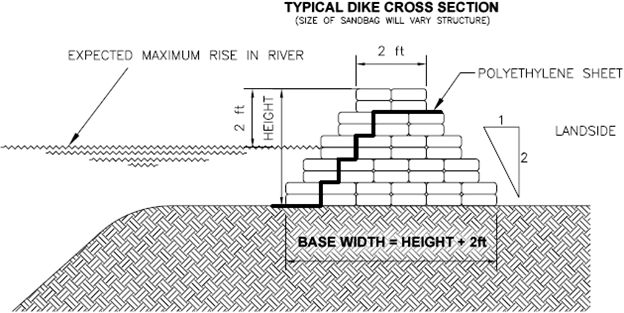
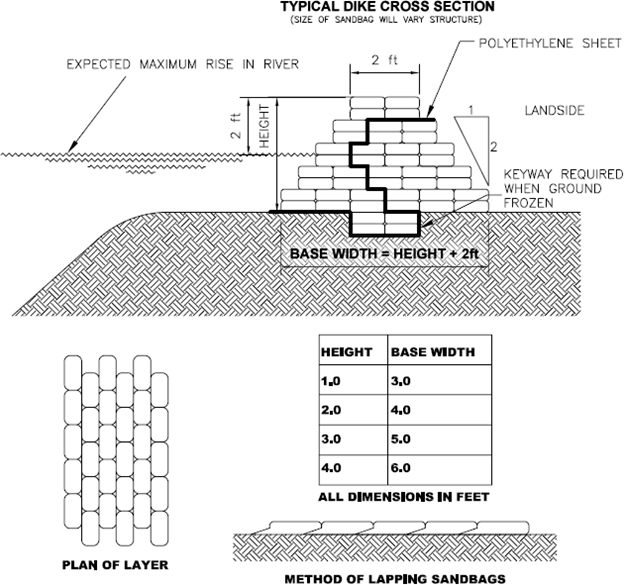
Here are some important tips on sandbag dike construction:
- The base area of sand bag dike should be clear of snow or ice prior to starting.
- To create a more secure dike, it is recommended to dig a core or cutoff trench (0.3m deep and 0.6m wide) beneath the dike.
- Leave at least 2.4m between a dike and buildings.
- Dikes should not be built on decks, patios, fences, planters, gardens, or any potential previous foundation.
- The base of the dike should be 0.6m wider than the ultimate height of the dike, E.G. Height = 1.2m, base = 1.8m Every second layer of sand bags should be set back 1/4 of a sand bag width, both on the water side and the land side of the dike, giving it a step-like appearance. The top of the dike should be 0.6m wide.
- The bottom layer of bags on the water side will run parallel with the water.
- Sandbags are to be tamped firmly into place.
- It is recommended that 6 mil polyethylene sheets in 3 m wide rolls be used as water proofing on the water side of the dike. The polyethylene sheet should be placed loosely against the sandbag dike during construction with a protective layer of sandbags placed on the water side as indicated in the diagram.
- Have extra sandbags on hand to strengthen any weak spots in the dike.
- If untied bags are used, the unfilled portion of the sack should be stretched lengthwise, and the next bag laid on top of it. This method is known as lapping as indicated in the diagram. It is not necessary to tie sacks. Untied bags should be filled to half full
For a visual guide to proper sandbag dike construction, please watch the North Dakota State University Sandbagging and Dike Building video on YouTube.